Emily Fisher
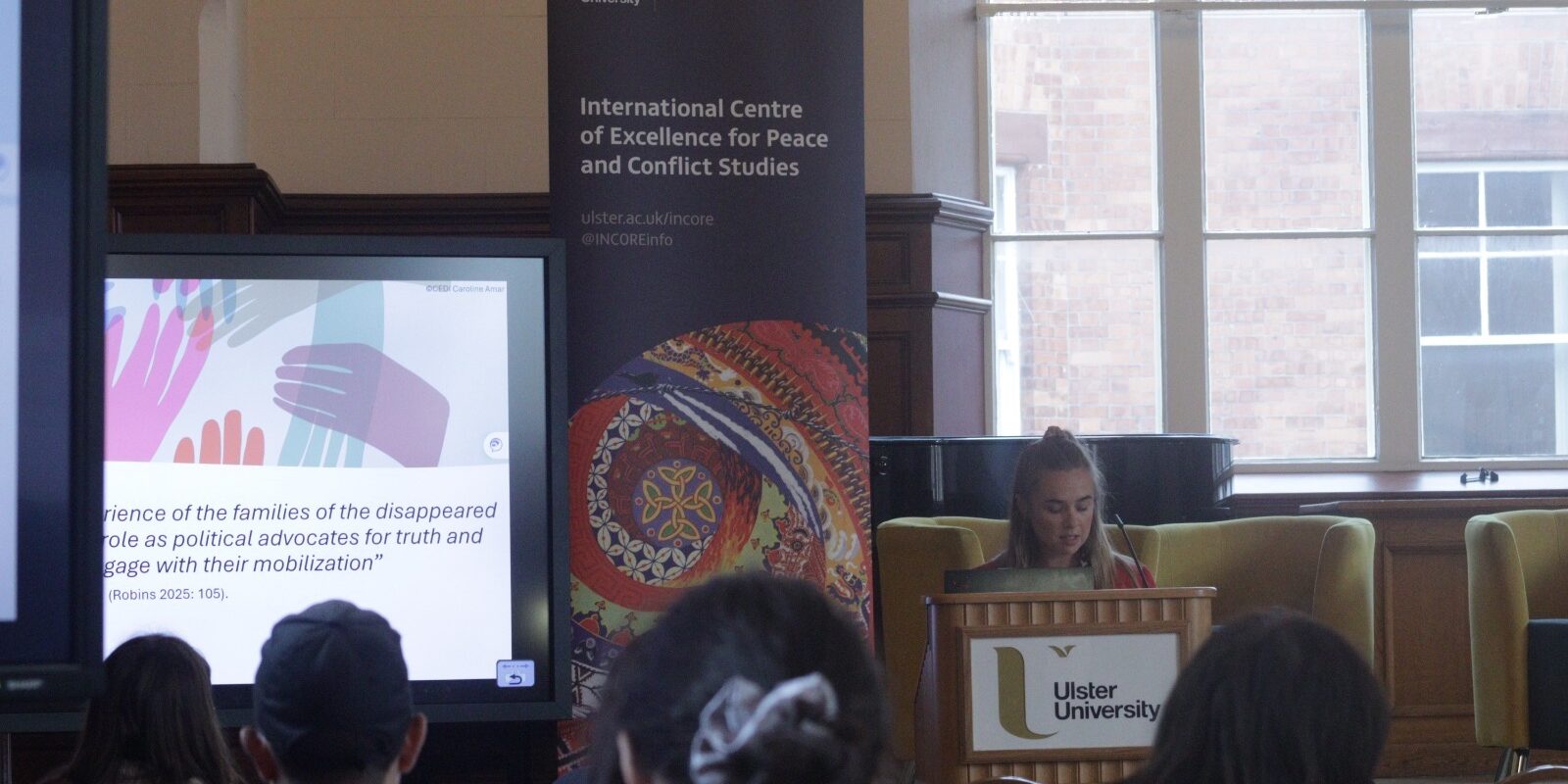
I spent several days in Derry attending, and presenting at the International Disappearances Studies Conference, the second of its kind, conceived of in conjunction with the new Disappearance Studies Journal. In attendance were researchers, practitioners and activists, (with many individuals a mix of all three!) working across contexts of enforced disappearance. There was a golden thread that ran throughout the conference of relational harm, how disappearance impacts not only the individual, but as a disruption of the social, emotional and political fabrics that surround them.
One of the early sessions attended focused on gendered and minority harms with several speakers who had all contributed to a recent Special Issue on forced separation: Chulani Kodikara; Rebekka Friedman; Phoebe Martin; Yajna Sanguhan and Elizabeth Barnert. A number of the presentations focused on Sri Lanka – for me, this was incredibly useful as through MaGPIE’s horizon scanning and my own PhD research, Sri Lanka has become a central focus. The panel attested to a continuum of violence, from the disappeared themselves, to the family members left behind having to grapple with structurally and symbolically violent bureaucracy. This, of course, resonated and reaffirmed – the very nature of the crime of enforced disappearance serves to send shockwaves into families, communities and even societal structures as a whole. Gender was also explicitly touched upon, both in relation to mothers and, the less commonly studied in this field, fathers. Kodikara’s paper attested to motherhood and family as a veil that is often used for organising but does not always protect. Motherhood is employed partly because they are then perceived as less repressible in public space, and partly because motherhood carries symbolic power across ethnic and political divides. Men’s experiences were also discussed in depth by Friedman. In contexts where the majority of the disappeared are young men, fathers form a significant, though often overlooked, group of searchers. Many attend roadside protests daily, even while referring themselves to the movement as one led by mothers. Their grief is shaped by gendered expectations: the sense of failing to protect their families, the guilt associated with masculinity, and the physical manifestations of stress such as cardiac illness. Despite taking on new care roles and responsibilities, fathers often find themselves marginalised from support structures that prioritise female-headed households. This was particularly enlightening as, similarly to Friedman herself, I had previously encountered only one other research paper that had explored the experience specifically of fathers in these deplorable contexts.
The conference also facilitated discussion as to where disappearance studies crosses into other experiences of harm and injustice, for example, Martin led a presentation as to the interrelation between disappearance studies and reproductive justice. Her geographic focus was that of Sri Lanka and Peru – a number of concepts were covered particularly that of the different harms that have long-term implications. In Peru, for example, forced sterilisation of rural Indigenous communities was discussed as part of a broader pattern of reproductive violence that intersects with disappearance. The nature of broader societal harms was something I had previously understood as predominantly relating to fear; fear of reprisal; fear of experiencing disappearance yourself; fear of further harm; ostracising and isolating. As such, this shone a novel light as to how the crime of disappearance can impact through generations.
Another presentation on the third day by Aruni Samarakoon again focused on Sri Lanka, but instead explored how women in post-war Sri Lanka use ritual and symbolism, including the figure of the goddess Kali, to build solidarity across ethnic and caste divides. Mobilisation becomes a form of narrative agency, allowing women to articulate demands for justice while navigating bureaucratic delays and institutional obstruction. Through shared ritual language, they attempt to create bridges between communities historically separated by conflict. This was again novel to me. All prior literature encountered regarding Sri Lanka suggested a somewhat rigid division between ethnicities searching for their loved ones going as far back as the formation of alternate Mother’s Fronts. This notion of solidarity is something I need to explore further within my own work on Sri Lanka so as to do justice to the nuance and heterogeneity within this specific context.
“Victim-led mobilisation” was another major theme. In Mexico, colectivos, groups of mostly women searching for the disappeared, operate under conditions of extreme risk. Ethnographic work undertaken by Luis Orlando Pérez Jiménez described how mobilisation is sustained through charismatic leadership, affective solidarity and the development of vernacular expertise. Searchers become skilled in many areas previously unknown to them, such as: law, forensics, and psychological support. Luis suggested that such knowledge is shared across borders and movements, and that where some collectivos focus on one specific aim, others will focus on another. This differed from my previous understanding of this context where another colleague working on the ground suggested that knowledge is more siloed – this had prompted ideas for future research projects enabling networking and information-sharing as this force is known to support searchers. Luis also indicated that journalists act as crucial allies, helping to amplify voices and document violence with A dónde van los desaparecidos as a predominant collective at the forefront of this support. Charlie McMackin, whose research also focused on Mexico, proposed the idea of “disappearing the disappeared” in relation to discussions of counter-archives and the struggle for truth and justice where families and activists create their own records and visual materials to resist erasure. These counter-archives challenge official narratives and insist on visibility, even when institutions attempt to obscure or minimise cases. This notion of twice disappeared, in line with my own research, is a frequent feature of these conversations bring credence to our suggestion of introducing that as a specific experience of harm and form of violence.
Border-related disappearances formed a significant part of the programme. A presentation on the Central Mediterranean by Giulia Sezzi highlighted how disappearance is produced through pushbacks, shipwrecks, and sociolegal exclusion and racialised border regimes expose certain groups, particularly Black migrants, to heightened violence. One case from April 2024 illustrated how multiple forms of disappearance can occur simultaneously: death in disappearance, a “normal” disappearance and a sociolegal disappearance, whereby individuals cannot access any legal identification within a country. Some of our work at MaGPIE focuses on investigating and mapping migrant mass graves through open-source data. Because deaths at sea are a devastatingly common occurrence, recently for example particularly in the Mediterranean off the coast of Libya, Mauritania, and Myanmar, I am familiar with the extensive restrictions and limitations families face when searching for their missing loved ones. On the same panel Michela Lovato asked the question as to how a disappearance can be restored, suggesting that there can in fact be no restoration without political recognition of the death and transformation of the structural violence producing it. Families of missing migrants navigate interactions with border authorities, solidarity actors and institutional systems that often maintain a “veil of disappearance,” even when bodies are recovered. Without political acknowledgement of the violence that produced the disappearance, restitution remains incomplete. Where States are both the perpetrator of the initial violence, and perpetuate the continuum of violence, recognition that could in any way satisfy devastated families and affected communities currently, in many contexts, seems a distant ideal. The question then arises as to how this recognition moves away from being performative in nature and towards meaningful structural change!
Discussions from Phevos Simeonidis on the Greek-Turkish border centred around ethnographic research undertaken in a Greek morgue specifically exploring how value is attributed to human remains. Phevos invited us to think of the body as three things: firstly, the corpse – the tangible body, then second the information surrounding the body and lastly, the dead body as the concept produced by States and used by States. This more abstract construction of the body took me back to my undergraduate degree and my understanding of Foucault’s bipolitics where the State, in managing life, also manages death – such theoretical understanding is of vital importance as it situates the practices of the State in a multitude of different ways beyond the original act of the disappearance itself.
At the end of this specific panel, the researchers reflected on their own roles within these systems, questioning how knowledge is produced, circulated and used. Attending a conference on disappearance brings a distinct feeling of unease—the discomfort of knowing there is an entire “industry” of us working and researching the horrific atrocities that people are actively experiencing. This is a tension and discomfort I constantly grapple with, a tension that does not have an easy answer – it should be our duty to contend with this – if we work within these fields with a sense of ease then we are ignoring how the systems we exist within can indeed contribute, if inadvertently, to global atrocity. To conclude this thought-provoking discussion practical suggestions ensued, such as centring collaboration with NGOs and civil society organisations to ensure that research contributes to practical change rather than remaining siloed in academia.
The final panels attended turned toward feminist approaches and other potential overlaps. Helena Rodríguez-Bronchú again traced connections between enforced disappearance and reproductive rights, suggesting that these fields have grown separately despite significant overlap. She also presented her mapping project documenting stolen babies globally (https://helenarbc.com/). Mapping, as something also undertaken by both MaGPIE and MPIP is always of great personal interest. Valentina Mendez Höcherl then intersected disappearance studies with migration studies, with a particular focus on the Mexican migration corridor, where, they argue, the disappearances of migrant women remain largely invisible. Mapping in this context was described as a challenge to State erasure, a way to assert presence and demand accountability. Counter-archives, whereby civil society and grass-roots organisations undertake the work that is meant to be enacted by States is a common occurrence throughout the world. This panel ended with Aimée Baker outlining artistic responses to disappearance that she has undertaken, including both poetry and an ongoing podcast – this is as a means to take their memory with us, even, or maybe particularly, when they cannot and will not be identified. This creative element was a continuing theme with film-screenings, the Conflict Textiles opening, and a practical creative exercise to close the conference.
Across all sessions, the conference underscored how disappearance is not a single event but a layered, ongoing condition. It shapes identities, relationships, and futures. It demands diverging analytical tools, feminist, intersectional, relational, and new forms of solidarity that recognise the complexity of harm experienced both from the original disappearance and the continuum of harm that continues.