Emily Fisher and Ellen Donovan
I can speak for both of us when I say that I was very grateful to be presenting our paper on the first morning of the first day of the DEAGENCY conference in Ljubljana. The conference focused on the ways that the dead interact with the living, through affecting thoughts, emotions, values, behaviour and social relations. Our presentation explored how the agency of the dead becomes weaponised against the living, in the form of a ‘second disappearance,’ when known and located mass graves remain unexcavated. As novel researchers, both having presented only once before, although confident in the work we had produced, were nervous as to how it would be received. These nerves were compounded by the fact that upon reading the book of abstracts we found that the author, Elisabeth Anstett, who acted as partial justification of our research, and who we directly quoted, would be the plenary speaker of the event. This meant, not only was she going to listen to our research ideas, but she would be in a position to offer feedback. Realistically, how lucky we were! As expected, she did offer constructive feedback, as to how the Twice Disappeared concept could be expanded to take account of other contexts where the State cannot be trusted to excavate or is not trusted by affected communities. Positioning we both implicitly knew but had not explicitly incorporated, reminding us of the necessity of conveying both the complexity, and multiplicity, of expectations that emerge through the possibility of exhumation.
Questions from the wider audience were in relation to why such a concept could not be applied to specific contexts they were working on, for example, we were told, in Slovenia, where bodies have been excavated and largely identified, but a final resting place remains a point of contention. Such feedback reinforced the need for us to explicitly state the foundations of the concept rather than just the specific applications we have been working on through our research, whilst also highlighting the possible breadth of its scope.
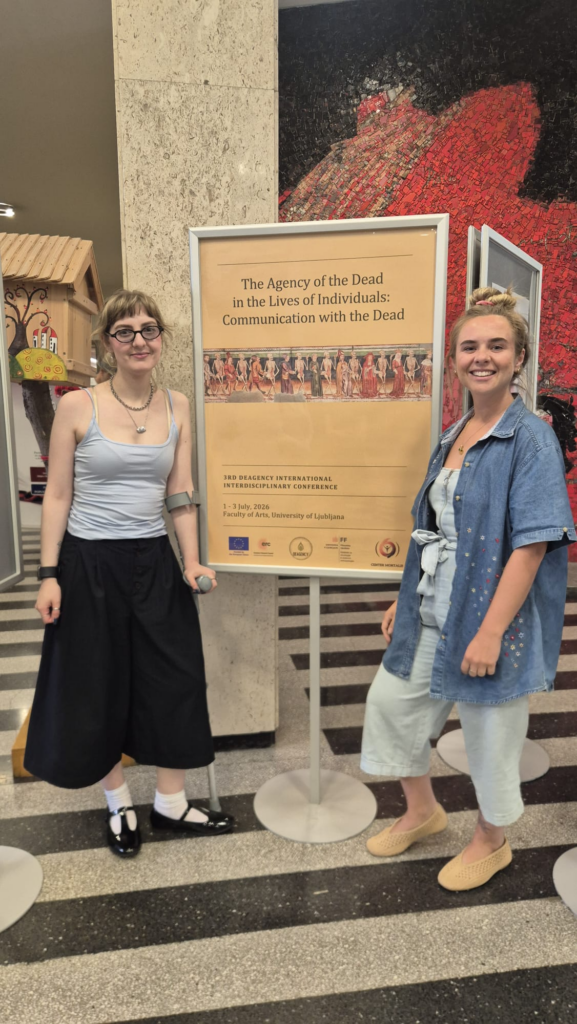 To be PhD researchers, right at the beginning of a research career, in an auditorium with individuals with such a wealth of experience really is a privilege of which to try and take advantage of. Subsequently, as interdisciplinary researchers, grounded in international law, social anthropology, and political theory, knowing the best lens to ‘frame’ your work without losing any disciplinary specificity can be a difficult task. In this sense, the theme of the conference brought in a wide range of ideas, approaches and contexts, from alternative spiritualities, the role of forensics, to mass graves and violent death, without losing its grounding in the notion that the dead play a significant role in social relations. Therefore, whilst we came away with a renewed focus for our paper, crucially we gained confidence in both the relevance of our research and its applicability across disciplines.
Day one, alongside our own paper presentation, we listened to several talks from across the anthropological spectrum, exposing ourselves to graves beyond the work we undertake at MaGPIE. For example, the town of Ami-Dong in South Korea that is, quite literally, built upon graves, sometimes even using the gravestones as building blocks. We spoke to Salman Hussein who is undertaking research with Pakistani families of a school-attack atrocity who are experiencing visits from their dead family members to continue to advocate on their behalf, understanding this as a ‘hauntology’. Two further authors presented their research regarding religious symbols and epitaphs on gravestones in both Slovenia and Czech from the discipline of ethno-linguistics.
Day two began with a presentation dedicated to AI and its interaction with the dead, specifically in relation to “resurrecting” of the dead through AI deathbots, or chatbots, built to act as the deceased individual, tending to take place due to motivations such as spectacularisation, sociopoliticisation or mundanisation. This was a truly fascinating topic, and one that I had, in no capacity, come across myself prior to the conference. We then went on to learn about the Katriver damn eastern cape of South Africa. Here, when the damn was built, the white bodies buried there were excavated, but over 1000 black bodies vanished meaning the community lost key means of vital communication with their dead. Stories have since arisen about menacing creatures in the damn, predominantly snakes, where some tell stories about an enormous serpentine being lives at the bottom, potentially indicating the severing of bonds with the living. The afternoon consisted of talks relating to “seers” in socialist Hungary and State propaganda surrounding such spiritual practices, then moving into the Dark Tourism of Bosnia and Herzegovina, attesting to difference between marked and unmarked places of memory.
The final day began with a presentation detailing how the forensic scientist exists within a multitude of worlds and how, it may be useful, to imagine them as a spiritual interpreter between the living and the dead. This paper also touched on the complexity of migrant deaths or as she phrased them ‘transnational deaths’. This was followed by a paper relating to migrant border deaths in Slovenia as a consequence of both contemporary border regimes and a weaponised landscape. Two further presentations explored the dead in moral relationships with the living and how that is experienced in a multitude of contexts. A very touching presentation detailed how academics, students and the community alike had grappled with mourning rituals in a secular society after the 2023 Prague Faculty of Arts Mass Shooting.
The conference concluded by summarising the range of topics into three key questions. Firstly, who controls the afterlife; who are the living and who are the dead, and crucially, who can have a say in how they are remembered? Secondly, how do we communicate with the dead; what is the influence of new technologies and contexts, and do they substantially change our relationship to the dead and if so, to what extent? Finally, how can morality and ethics be conceptualised in relation to the dead; who controls communication between the living and the dead, and what traces can be left behind when the voices of the dead are suspended or silenced?
As with these research topics, you often come away with more questions than answers. Anthropologists are particularly practised in ‘following the thread’ and such discussions remind you that when you pull on the thread of a specific human experience, it rarely ever ends.