Melanie Klinkner
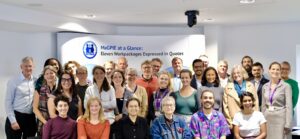 Year three started just off the back of a real highlight and milestone: our first expert convening where in collaboration with experts from across the world we began to better understand what changes may need to be made to Bournemouth Protocol on Mass Grave Protection and Investigation to ensure it reflects migration law, data and investigation efforts, whilst giving credence to family voices, cultural rights and commemorative practice.
This display of a real team effort, for which I am much indebted to each member, continued across the year. Thematic foci for the team have been: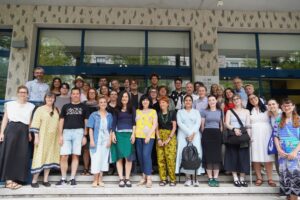
- Continuing to establish networks and partnerships with research teams across the world, from the Cyprus-based DISACT team, the DEAGENCY research group in Ljubljana to the Observatório do Desaparecimento de Pessoas no Brasil (ObDES);
- Engaging with and learning from those working at the intersection of legal, anthropological and forensic expertise, through research stays at the Max Planck Institute for Social Anthropology in Halle to continued field-work by PhD Candidate Anna Charlton in Western Australia.
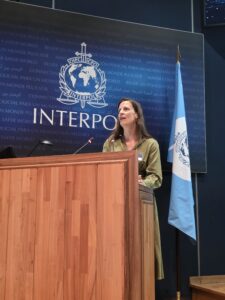
- Presenting at forensic conferences, law enforcement gathering and migration-oriented research groups.
In so doing we are continuing to develop conceptual and methodological frameworks based on our core values of dignity, truth, integrity and collaboration. We work to advance victim-centred and scientifically robust approaches to mass grave protection and investigation that respect the dead and serve the living. We seek to place the rights of victims, the missing, and their families at the centre and aim to develop and promote practices that uphold human dignity, accountability, and the rule of law.
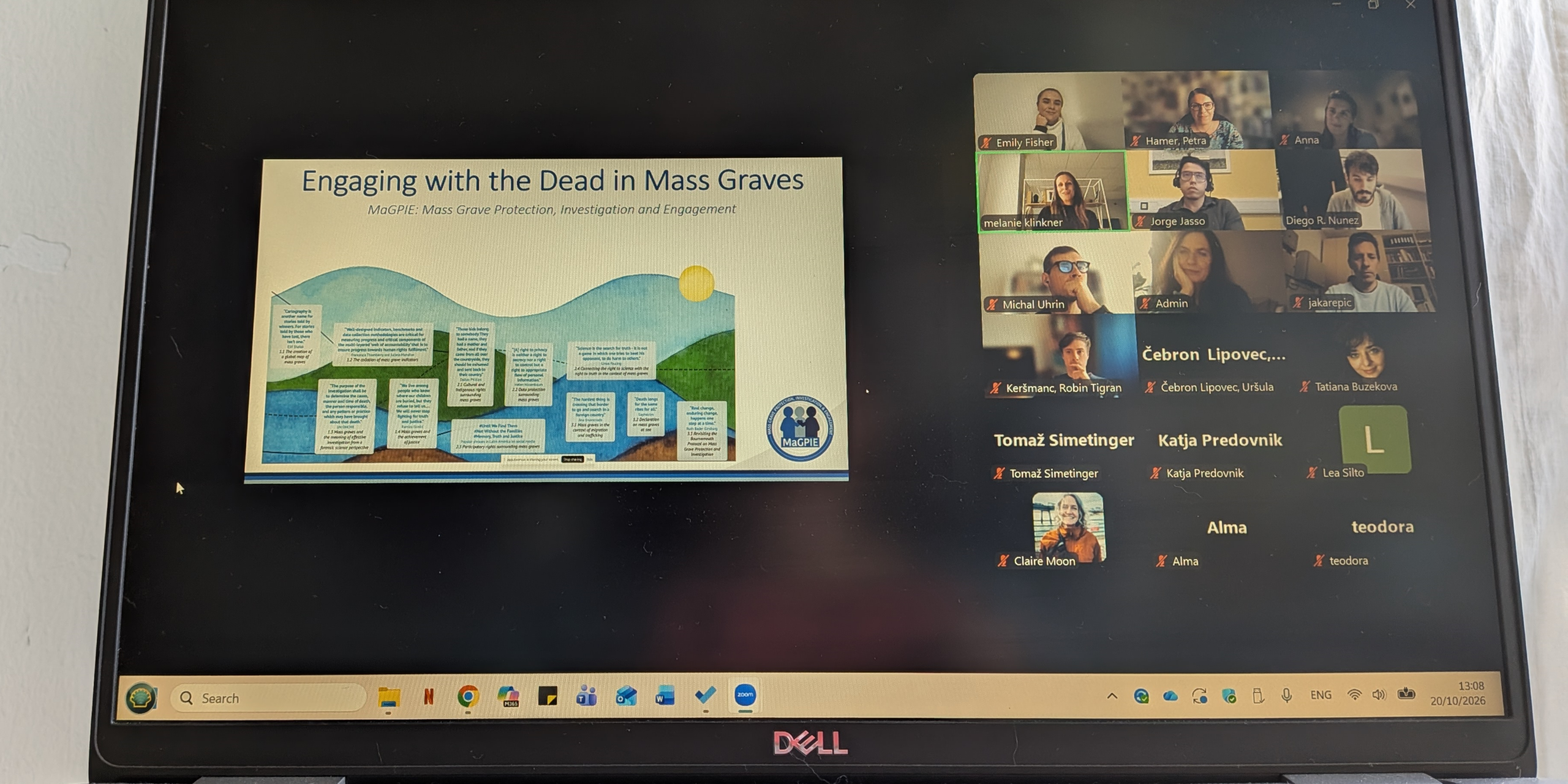
Key insights from our research were clearly visible at our recent, team-based online lecture where team-members reflected on one main question: “What does engaging with the dead mean through the work of MaGPIE?”
Here I canvas three answers:
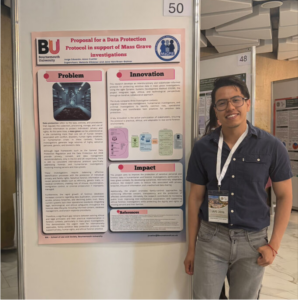
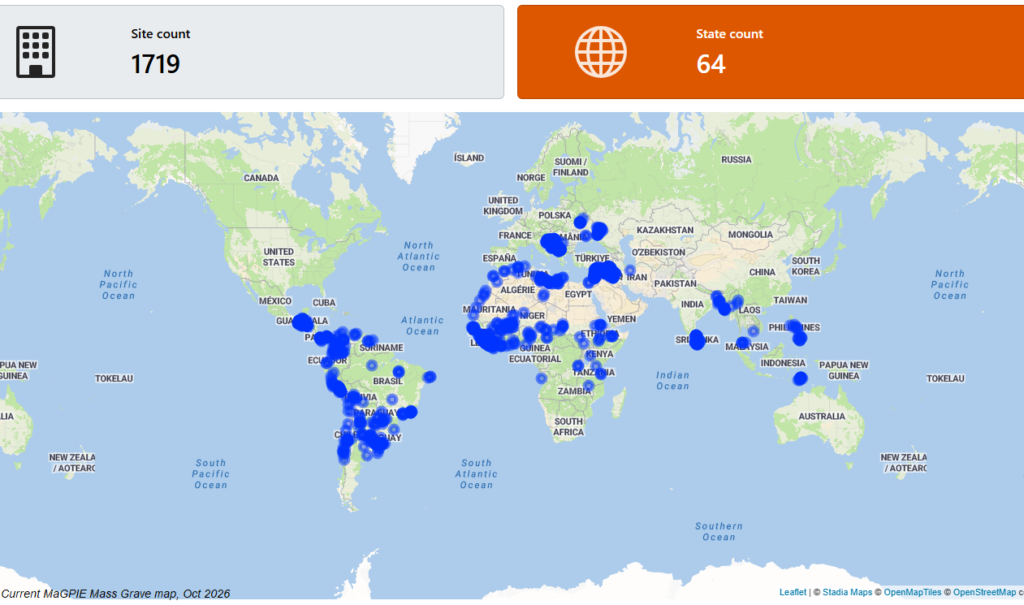
- The extent to which mass grave investigations sit at the intersection of multiple objectives and that while seeking to have a global outlook, context and site-specific events really matter. This is evident in the global mapping exercise, where, in line with the life-cycle of the mass grave, data points have been created to capture richness of data in as uniform a manner as we can.
- Cognisant of the limits that stringent data categorisation present, MaGPIE’s theoretical work proposes the concept of “suspicious necro-site” to account for the diverse forms, spatial and temporal dynamics that surround sites of death, resting places, disturbances and investigation thereof. The word suspicious serves to emphasise the legal (and with it forensic) response that such sites require.
- From a cultural anthropological perspective, the concept of suspicious necro-site allows for in-depth examination of, for example, activism around mass graves, or the complexities of Indigenous unmarked graves thereby foregrounding the different ways in which sites of the dead become known, contested and significant.
 As one might expect, aspects of the data we collate and analyse is confronting A frequently asked question the team receives is: “What keeps us going on this path?” The research we conduct occurs for events that already happened: it is too late for those that have died. But what happened has profound implications for the living. And advancing knowledge on how and why mass graves matter will help inform better laws, policies and strategies to protect and engage with them.
What is next: our next big team task will be to implement the lessons and feedback from September 2025 roundtable. Over the coming months the MaGPIE team is working to comprehensively revise the Bournemouth Protocol so that it can continue to serve as a policy document in relation to the life-cycle of mass grave protection and investigation whilst expanding on the contexts in which mass graves occur, acknowledging the differences these contexts bring and thus adding depth and breadth to the original document.
The core aim remains the same: to inform and guide practice in relation to mass graves and the dignified, respectful, non-discriminate and lawful handling of, and engagement with, human remains. We are grateful to the many partners, practitioners and communities who have shared their expertise and experiences, and we look forward to continuing these conversations in the next stage of the MaGPIE journey.