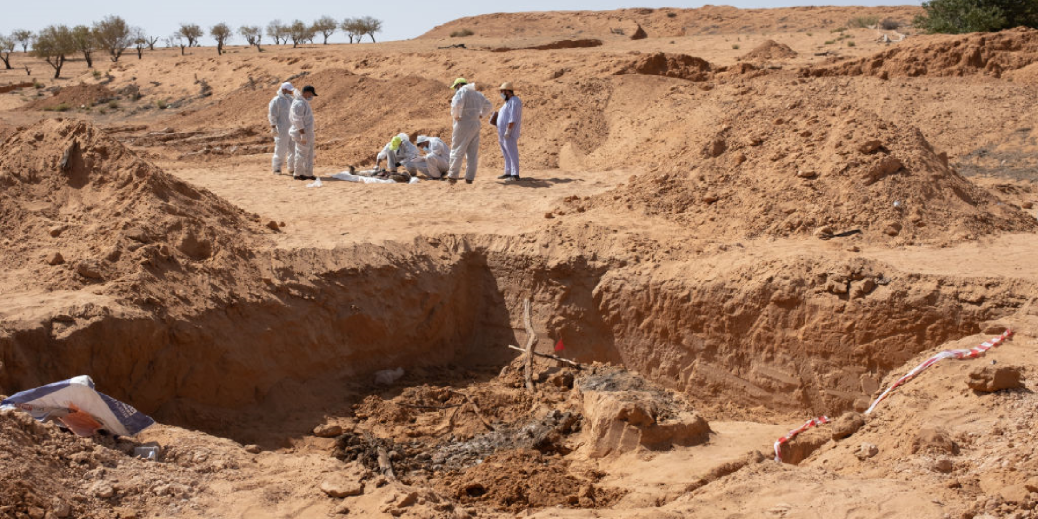
Image- Libya mass graves reveal 25 more bodies
Ellen Donovan
Much of MaGPIE’s pillar one effort is concerned with the production of a global, open-source map of mass graves which involves gathering multiple data points related to each site. Arguably, the most essential of these data points are site status and site structure. Site status denotes whether the site is exhumed, partially investigated, recorded, witnessed or disproved, and site structure is whether the site is an in-ground burial, remains are scattered on the surface, left in water, in a cemetery, or in natural or manmade structures. But other factors, such as political will and governance play a vital role.
Through analysing and comparing data, we can gain a better understanding of why some mass graves may come to be excavated to advance identification of victims and redress and others not. This blog will focus on two examples of events that have led to mass graves in Libya; sites in Derna, Sirte and Benghazi linked to Islamic State, and sites in Tarhuna linked to the al-Kaniyat militia and the Libyan National Army (LNA) led by General Khalifa Haftar.
Our records thus far
The status of mass graves in Libya is both varied and wide-ranging, with 28 sites exhumed, 20 partially investigated, 15 recorded, 1 witnessed, and 1 disproved, even though all 66 sites recorded by MaGPIE are dated within a similar time period, post 2011. The data on site structure is patchy in Libya and shows 17 in ground burials, 7 in manmade/natural structures, and 3 surface scattered sites. From the perspective of site status, Libya therefore presents an interesting opportunity to analyse both how and why some mass graves come to be excavated or not exhumed, particularly given similar temporal and geographic proximity.
From political vacuum to political will
With the political vacuum left by the Gaddafi regime after 2011, and loss of a uniting common adversary for the newly organised militias armed by NATO forces, Libya to date has been marked by conditions equivalent to a failed state. 50 out of 66 mass graves in Libya are dated to this period, with a wide range in the site status; 14 have been exhumed, 13 partially exhumed, and 14 recorded.
From 2014 to 2020 the Second Libyan Civil War was fought between the UN backed and internationally recognised Government of National Accord (GNA) and the Libyan National Army (LNA) led by General Khalifa Haftar. The LNA committed numerous war crimes and crimes against humanity, including torture and mass summary executions. Specifically, after the fall of General Haftar in 2020 16 mass grave sites were discovered in Tarhuna and UNOSAT imagery indicated up 100 uncovered mass grave sites, with the victims executed or tortured to death in clandestine detention centres by the LNA aligned Kaniyat militia. The sites in Tarhuna have received a great deal of both domestic and international attention. In October 2024, the International Criminal Court (ICC), as part of the 2011 UNSC resolution, unsealed arrest warrants for six Libyan nationals associated with the Al-Kaniyat militia. The UN Support Mission in Libya (UNSMIL), the Office of the High Commissioner for Human Rights (OHCHR), and the Independent Fact Finding Mission on Libya (FFM) have published reports that detailed severe human rights violations including extrajudicial killings, enforced disappearances, sexual violence, arbitrary detention, and forced displacement. The 2022 FFM report identified 3 locations of mass graves in Tarhuna, and on its behalf UNOSAT corroborated the location of 7 mass graves in Tarhuna through satellite imagery analysis. In June 2020 the Prosecutor General’s Office in Libya issued a statement confirming the appointment of a team of forensic experts to carry out exhumations, calls for testimonies, arrests of indicted persons, and cooperation with the ICC investigation.
Governance and legal framework
Notably, increased international political attention and political will did not translate into exhumations on the ground. Out of the 16 identified sites, 7 have been exhumed and 1 partially exhumed, a figure that is considerable when also accounting for an estimated up to 100 uncovered mass grave sites in Tarhuna. Whilst the reasons behind this are multifaceted, they also reflect the wider collapse and fragmentation of central authority in Libya. The current legislative framework governing exhumations and identifications in Libya is complex, with multiple organisations with the same or similar jurisdictions, resulting in the siloing and duplication of data and confusion over differing mandates. Within this picture, the structuring of governance of Libya means that site security is provided by various militias. In practice, the shifting and complex lines of authority both within and between militias and between different state institutions not only dictates access to sites but also acts as a de facto governance structure over the exhumations themselves. In Tarhuna exhumations have been dependent on the militia DACTO, which has information on the location of sites obtained by interrogation from the DACTO controlled Mitiga prison. However, exhumations have been halted since August 2023, after the 444 Brigade militia prevented access of DACTO militia into Tarhuna.
The fragmentation of authority in Libya also left it vulnerable to infiltration by criminal networks and extremist organisations such as Islamic State. Libya’s land and sea borders have been characterised by extreme porosity, not only of migrants and refugees travelling north to Europe facilitated by criminal gangs, but also of weapons, further entrenching lines of control by variously aligned militias. The religious sphere was previously heavily regulated by the Gaddafi regime, and extremist religious groups exploited the lack of state presence. Islamic State took over the cities of Benghazi, Derna and Sirte in 2014 and 2015, relying heavily on foreign fighters from Syria, Iraq, Chad, Mali and Sudan, whilst also recruiting many former Gaddafi supporters excluded from positions of power after the uprising. Like other areas under Islamic State control at the time, such as Raqqa in Syria, and Sinjar and Mosul in Iraq, alleged gross human rights abuses and war crimes were committed in Derna and Sirte. After the fall of Islamic State in Libya 22 mass graves to date have been discovered in Islamic State controlled territory.
Thus far, 20 of these sites, the majority in Sirte, have been exhumed by The General Authority for the Search and Identification of Missing Persons (GASIMP), a much higher rate of exhumation than in Tarhuna. Whilst international pressure to address human rights abuses by Islamic State may have been at play here, the data shows a relative lack of international involvement or attention to the mass grave sites. Despite frequent coverage of Islamic State during 2015 to 2017 in UN fact finding reports, only one report by UNSMIL in 2023 mentions mass graves linked to Islamic State. Open-source information on these sites is usually only available in local or national Libyan news sources, aside from high profile cases such as the execution of Coptic and Orthodox Christians. Even so, the concerted effort to defeat Islamic State did impact exhumations. In contrast to Tarhuna, the involvement of militias in Sirte was less frictional. The Misrata based coalition of militias, the al-Bunyan al- Marsous operations room, was involved in retaking Sirte from Islamic State with the GNA. After the conflict they were also involved in explosive ordnance and mine clearance operations in Sirte, recovering the remains of Islamic State members, and identifying former Islamic State positions such as detention centres. In practice, it can be inferred that a more stable flow of information on the location of sites to GASIMP resulted in higher rates of exhumation in Sirte than in Tarhuna.
What can the data tell us?
The examples of Tarhuna and Sirte demonstrate the value of documenting and recording mass grave sites, as well as the potential of doing so to identify underlying patterns across cases. Whilst there are many complex factors involved, differing rates of discovery and exhumation of mass grave sites in Libya draws attention to the gaps between political will, international attention and effective governance. Considering the significance of effective mass grave investigations to the realisation of truth, justice and accountability, recognising the interplay of these dynamics is essential.