
Emily Fisher
Horizon scanning is an element of MaGPIE that enables us to keep abreast of how things are developing across the world in relation to both mass graves and mass atrocity in real time.
The nature of seeing how things are unfolding in real time is that they are not subjected to as many checks and balances as the data that will eventually make it into our mass grave map. Because of this, it essentially acts as a temperature check of news relating to mass graves globally. Oftentimes this will then translate to data being added, or updated, by our data researchers.
When I talk to friends or family about this aspect of my work, they always ask, how many alerts do you get? One, or maybe two a week is their first guess. When I tell them I go through nearer to 100 per week, the shock and confusion always registers on their faces. They then almost always ask, does that mean there are a hundred new mass graves discovered a week? Well, no – at least, not that we can ascertain through open‑source alerts. Targeted alerts are received through both Google and Talkwalker every day, with news specifically containing the phrase “mass grave.” Sometimes these are not useful; for example, it could be a sidebar pointing to another article that contains information relating to a mass grave. We also subscribe to receive news from Human Rights Watch, IOM, ACLED, the UN, WGEID, amongst others. As such, although we read through many alerts, a vast number of these never make it into our database. It is important to note that horizon-scanning also pertains to any updates to do with mass graves globally. For example, some of the most recent entries in our database are as follows:
- Libya, 1st May – Four individuals found in a mass grave in Abu Salim have been identified.
- Sri Lanka, 27th April – Excavation at the Chemmani mass grave has recommenced.
- Spain, 25th April – A Princess Cruise ship recovered five bodies from the water while on its way to Spain.
Another recent one of interest would be the arrest of a former Syrian regime official in relation to the “Tadamon massacre.”
Each entry in our database pertains to some work package being undertaken by MaGPIE and is recorded as such. This enables the relevant team member to track horizon‑scanning entries specifically relevant to their work. For example, point one, Libya, is relevant to both the global map of mass graves and the work package engaging with mass graves and migration, as Libya is a known transit country and has encountered migrant mass graves in the recent past. Point two, the Sri Lanka excavation, is relevant to the global map in regard to the status of specific mass graves. It is also pertinent for both myself and Ellen, who are working on our Twice Disappeared concept with Sri Lanka as a case study, a concept which we will be presenting at the upcoming DEAGENCY conference in Ljubljana. Point three, Spain, is maybe a more allusive connection in regard to the map, asking the question as to whether bodies of water (such as the Mediterranean, where hundreds go missing or die every year) can constitute a mass grave, but it is also relevant to mass graves and migration as attested to earlier.
Additionally, all horizon‑scanning entries help to establish a global picture:
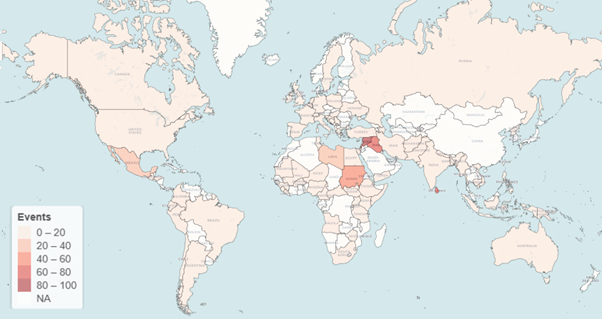
This map gives the impression that Syria, Iraq, Sri Lanka and Sudan are all “hot spots” for horizon‑scanning data entries. For many, this would not be surprising, with these countries either in active conflict or grappling with post‑conflict processes. However, Mexico and Libya also stand out – Libya, as mentioned earlier, in relation quite often to migrant mass graves, and Mexico as more and more missing persons related to migration, trafficking, drugs and cartels are being found across the country by many different means.
Horizon scanning also sorts the data entries into categories:
- New mass grave
- Information on known mass grave
- Country context
- Legislation
Based on these categories, 11 entries pertaining to “New mass grave” have been added since 1st April. Again, it is important to reiterate that this does not amount to 11 mass graves having been created during this time frame. More often than not, such alerts are in relation to the discovery of mass graves. As such, they are “new” as information had not previously been publicly available about them.
Taken together, horizon scanning allows us to maintain a live, responsive understanding of how mass graves are being discovered, and addressed (or not!) around the world. While not every alert becomes a data entry, each one contributes to a broader awareness of global patterns and the ongoing struggles faced by families and communities. It is this continuous, careful monitoring that ensures MaGPIE remains grounded in real‑time developments while supporting the projects long term research aims.