Ian Hanson
The world has come a long way in the last three decades in terms of undertaking forensic investigation of atrocity crimes. The Principles on the Effective Prevention and Investigation of Extra-legal, Arbitrary and Summary and Article 15 of the International Convention for the Protection of all Persons from Enforced Disappearance state forensic investigation and identification efforts may form part of an ‘effective investigation’, that successfully fulfil obligations including an authoritative account of events, including confirmation and certification of death, and leading to compensation and other rights.
The following cases studies[1] exemplify the complexity, variation, and progress in developing processes of investigation that are ‘effective,’ providing evidence to address human rights violations in the last 30 years.
Investigations and On-Going Atrocity Crimes in 1996
Rwanda
Thirty years ago Rwanda was dealing with the aftermath of the 1994 genocide that saw the killing of an estimated 800,000 victims in 100 days. The subsequent creation of the International Criminal Tribunal for Rwanda (ICTR) by UN resolution was followed by a limited number of forensic mass grave exhumations in 1995 and 1996. The first trial on genocide charges started in January 1997, but forensic evidence was not provided, a decision made not to exhume relevant mass graves. The initial forensic exhumations by Physicians for Human Rights (PHR) recovered 520 victims, revealed evidence of mass killings, but with limited identifications.
Guatemala
At the same time in Guatemala, the signing of the peace accords in December 1996 ending the 36 year-long civil war. The UN sponsored Commission for Historical Clarification was implemented, documenting related human rights violations. NGO human rights investigators including the newly formed Forensic Anthropology Foundation of Guatemala (FAFG) continued the long task of documenting events around an estimated 45,000 Missing persons from the conflict. Investigations took place in the face of significant opposition from elites and state institutions.
Iraq
In 1996 in Iraq, under the regime of Saddam Hussein, political prisoners were held and frequently executed in Abu Ghraib prison, by the security forces and a complicit judiciary. The Iraqi army persecuted minority Kurdish and Turkmen populations in the North, including the communities around Halabja subjected to chemical attacks in 1988, and still suffering. Purges saw executions of dozens of senior military officers. The Shi’a marsh Arabs and tribal groups were persecuted in the south, with villages and crops burnt and artillery used on civilian populations.
Cambodia
In Cambodia in 1996, low level conflict continued, after 20 years of totalitarian regimes and conflict in which estimated between 1.671 and 1.871 million died (21-24% of Cambodia’s 1975 population). Hundreds of mass graves were being exhumed without standard forensic methods by local communities as a politicised memorialisation. In many cases skulls and other bones were gathered and built into memorial pavilions (stupas). Negotiations between the United Nation and Cambodian government to set up a court began in 1997, with The Extraordinary Chambers in the Courts of Cambodia (ECCC) formally established in 2003 to try senior leaders responsible for crimes against Cambodian and International law that were committed between 1975-1979.
Bosnia and Herzegovina
Following the ending of the conflict with the Dayton Peace Accords in November 1995, the first PHR forensic field team deployed to Bosnia and Herzegovina (BiH) in April1996, to assist the Criminal Tribunal for the Former Yugoslavia (ICTY) to locate mass graves related to the alleged Srebrenica massacres. With an as yet unknown number of victims, some graves had been located in August 1995 by journalist David Rohde, of The Christian Science Monitor, and had also been pinpointed on aerial imagery released by Madeline Albright, the US Secretary of State. Some of these sites were focused upon to gather evidence for prosecutions in 1996.
The Development of Responses: BiH and Srebrenica
BiH as a case study remains the most useful example to illustrate how progressive process developments in investigations have developed in the last 30 years. This is in no small part because of the resources put into investigations, the response to the needs of both ICTY and national prosecutions, and domestic efforts to locating the missing, in the aftermath of the first forensic work.
The 1996 ICTY investigations had demonstrated the scale and complexity of mass grave scenes, and the complications caused by managing the recovery of large numbers of victims. Processes were refined by ICTY during 1997 to 2001, and it was realised that many mass graves had been systematically disturbed by perpetrators moving remains to impede investigations. Evidence linked scenes, and a range of atrocity crime scenes were examined including detention centres, execution, and surfaces sites. Evidence related to Srebrenica began to be used in trials, for example with the 2000 General Radislav Krstić trial. He was found guilty (2001 and on appeal 2004) of aiding and abetting genocide.
One of the immediate problems that arose for ICTY in 1996-2000 was that the recovery of thousands of cases of remains, while providing evidence for the court, resulted in the storage of victims in containers, without identification. This caused great anguish among families. BiH commissions had in parallel recovered thousands of the missing, with some 8000 identified through presumptive means in the initial post-conflict years. The International Commission on Missing Persons (ICMP) strongly supported victims’ families, including the Association of Women of Zepa and Srebrenica, to help address the identification issue, and began a scientific program to determine how to identify the Missing.
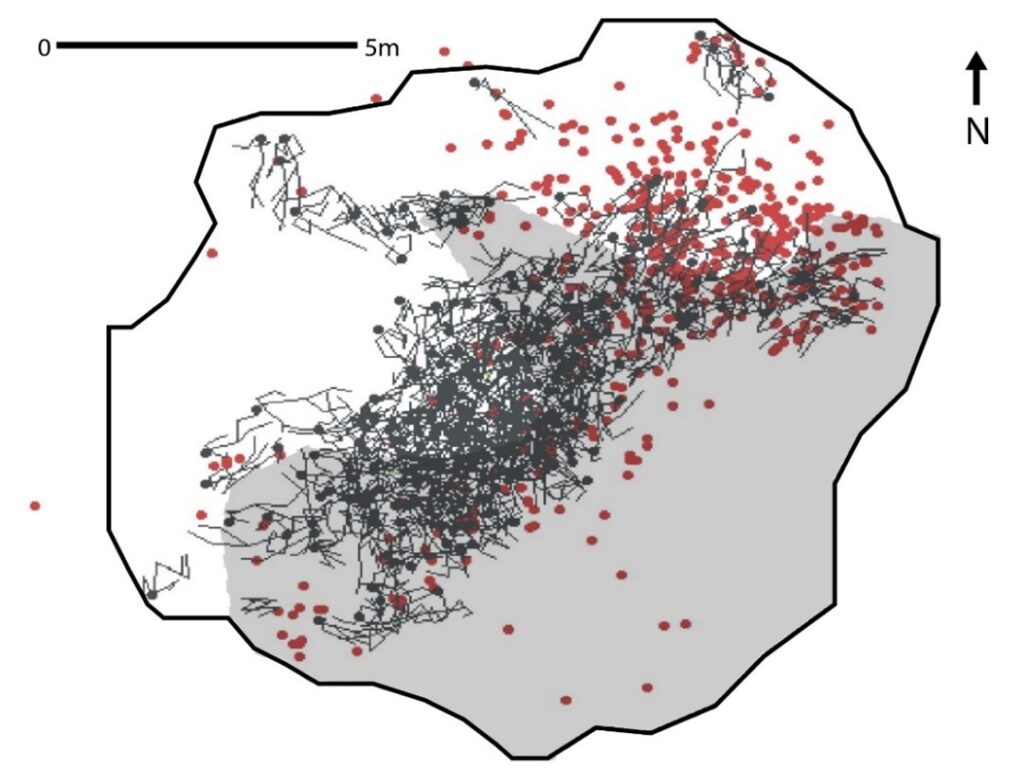 Survey of 270 bodies, 156 body parts and shell casings from the Srebrenica related Kozluk mass grave (KK3), excavated by ICTY in 1999. Evidence was used in the Krstic and subsequent trials. The site was re-excavated in 2015, and another grave found.[2]
It was not until 2001 that the ICMP DNA matching lab came on-line, and the mass identification of victims began an unprecedented acceleration, a national campaign gathering reference blood samples from families, so that matches could be made. In some regions of BiH 97% of registered victims’ families came forward to donate samples. The innovative examination, DNA matching and re-examination was highly successful. A result of this was that the DNA matching evidence not only provided identifications, but the body parts of individuals found in different graves linked crime scenes, and provided demographic data as to the fate of thousands of the Srebrenica victims. This evidence was utilised in a series of trials at ICTY .
The procedure for taking DNA samples, and the use of ICMPs lab to match identifications was expanded across BiH coordinated by the Missing Persons Institute, assisting all communities. The standard operating procedure (SOP) for sampling was disseminated globally. The body part matching processes were also utilised across in north-west Bosnia, where the robbing of graves had also occurred.
National authorities undertook the recovery of all of the missing after 2001, continuing (with the assistance of ICMP) the provision of identification evidence to national courts and ICTY. By 2012, all national war crimes court cases had been transferred to the State Prosecutors Office, but there were considerable backlogs. ICTY cases and evidence were transferred to the BiH State Court.
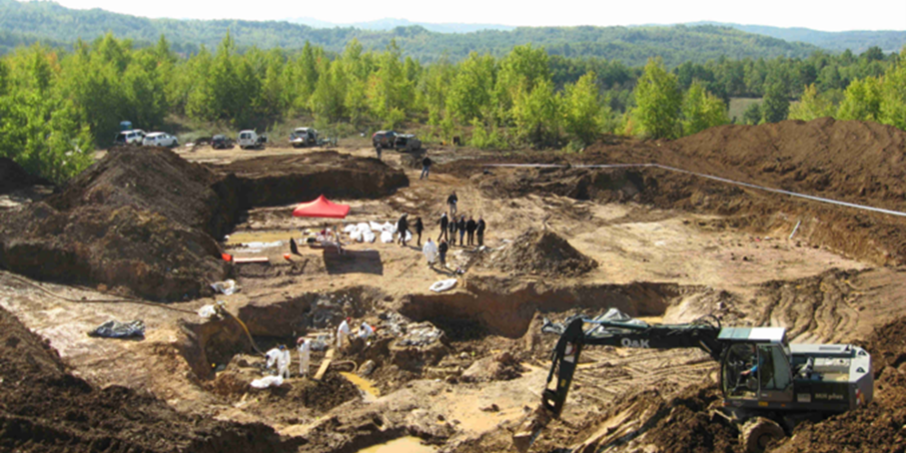
From 2013, review of previous excavations led to a series of re-excavations of mass grave sites, including Tomasica near Prijedor, the re-excavation leading to evidence being introduced into the General Radko Mladic trial in 2015. Hundreds of new identifications were made, the DNA matching data re-associated body parts, connected primary and secondary graves, with the identifications linking victims to criminal events.
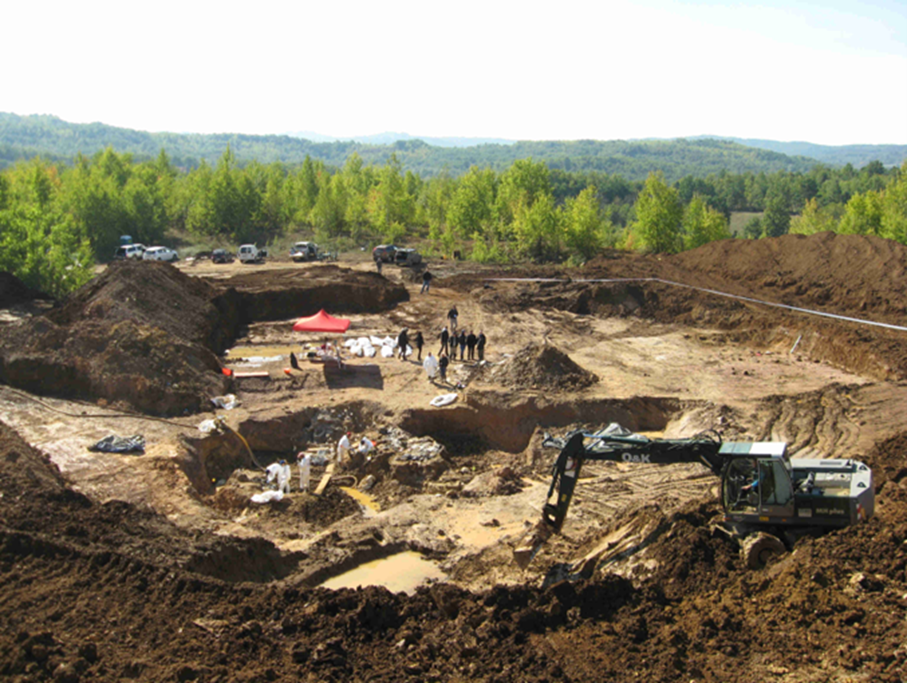 The excavation of the Tomasica Mass Grave near Prijedor, northwest BiH, 2013
At the same time a review was undertaken of all mortuary facilities across BiH which held over 3200 unidentified (NN) cases of remains. The ICMP process of examination and DNA sampling was refined and utilised systematically, resulting in new identifications and determination of ways to close two thirds of all cases. All cases came under national coordinated database management for the first time. The process confirmed a known issue – that of misidentification of victims – that has not been previously fully addressed As the NN review was completed in 2018, a process to address misidentification developed, widening to a regional coordination.
As of 2025, the backlog of BiH State prosecutions was reduced to around 200 cases, with many unable to be completed as perpetrators are at large. The focus on trials reduced resources to investigate the locations of missing persons, and there were limitations to coordination and data sharing between agencies undertaking investigations. Political impediments to pursuing investigations have remained.
As of July 2025, 7022 victims of the 1995 Srebrenica genocide have been formerly identified, 99% through DNA matching analysis by ICMP, of an estimated 8000 victims, many buried at the Potocari Memorial cemetery as a central focus for remembrance. Around 90% of Srebrenica victims have been accounted for (against some 72% nationally), figures unmatched in any other investigation. In 2024 General Krstić, (now aged 78) admitted his guilt, appealed for early release from his 35-year prison sentence, and asked victims’ families for forgiveness. Early release was not granted.
Reparations for families were not built into the Dayton Peace Accords. The BiH state and entities provide war pensions to widows and victims, though the system is complex. Domestically, survivors have claimed reparations from perpetrators through lengthy and costly civil proceedings. Srebrenica families turned to international avenues. They sued the Dutch government for compensation after ICTY trials provided mass identifications and criminal event verdicts, and in 2024 a settlement scheme was set up after a 2019 Dutch Supreme Court verdict to pay 2337 families some 25 million euros as compensation for Dutch Army failures in 1995.
The development of responses in BiH over 30 years demonstrates the potential for successfully gathering evidence of atrocity crimes, identifying the Missing and determining the narrative facts about atrocity crime events.
The Situation after 30 Years
In 2026, we see the wider global application of some of the processes initiated in the Balkans, though this is uneven and partial. The number of DNA labs able to match victim and family samples has grown considerably. Use of remote sensing is frequently employed to pinpoint possible atrocity crime scenes, including mass graves, utilising commercially available high-resolution imagery. The availability of such evidence has increased greatly, as has widespread recording and distribution of alleged events using social media, though this remains, in many cases, circumstantial evidence. However, many events globally remain under investigated on a formal basis.
Rwanda
In Rwanda it took until 2006 for the ICTR Appeals Chamber to state in a judgement that a genocide against the Tutsi ethnic group took place in Rwanda in 1994. The tribunal indicted 93 individuals (with 83 arrested). The evidence gathered by initial forensic exhumations in 1995-1996 by PHR was used successfully in one joint trial, but discounted in another, exhumations deemed not scientifically rigorous enough to support the conclusions presented by the Prosecution. No further ICTR forensic investigations took place, the Rwandan government opposed a forensic approach and the slow prosecution process, with tens of thousands of accused in detention, leading to the local gacaca court systems set up to speed the justice process, hearing 1.9 million cases and convicting 1,681,648 individuals, by 2012. The gacaca system, unlike ICTR could make reparations, though these were limited. The limited list of ICTR fugitives were successfully accounted for in 2024, however, authorities are still seeking 1,000 génocidaires. Mass graves of genocide victims are still uncovered on a regular basis, prompting new memorialisation efforts. As of 2026 there has been little formal identification of victims in Rwanda, and there has been a slow development of forensic science support nationally.
Guatemala
In 2026 in Guatemala, the practical progress in forensic investigations made since 1996 has seen FAFG develop their own validated DNA lab, which has contributed to ground-breaking work in recovering and identifying the Missing. Forensic standards improved after 2000 with the need to use evidence for trials such as that of the former President Rios Montt. The work of several NGOs has contributed to national prosecutions, including on-going cases concerning the Ixil (Mayan) genocide. Victims sought justice abroad in Spain and from the Inter-American Court, who found the Guatemalan state guilty of multiple human rights violations and ordered reparations. The counter-efforts to limit investigations saw attempts to coopt Guatemala’s judicial institutions and prevent prosecutions. Attempts to create a missing persons law in 2016 have not been completed. The forensic work of NGOs is not integrated with Guatemalan state’s forensic capacity, though formal coordination with the Justice Ministry under standard protocols has been in place since 2002. Resources remain limited, with a reliance on international support from the US and other governments, as well as donor foundations. Though a National Reparations Program was established in 2003, a lack of political support has seen budgets and capacity reduced to the point it fails to provide compensation. Memorialisation relies on NGO and grassroots initiatives, and some 18% of the Missing from the Guatemalan conflict have been accounted for, as 8300 cases, recovered from 1196 sites.
Iraq
Iraq saw formal investigations of Saddam Hussein and his regime after the fall of Baghdad in 2003. Mass grave evidence was provided by internationally staffed forensic teams working for the Coalition Provisional Authority (CPA) in 2003-2004 to the Iraqi High Tribunal. The CPA estimated there were at least 300,000 victims from the Hussein’s regime, with ICRC continuing to gather data on the Missing. From 2008 ICMP built a capacity building program to support Iraqi government efforts to find the Missing under the Mass Graves Directorate. The teams had recovered over 5300 cases by 2014, excavating 160 mass graves. Over 560 mass grave sites had been mapped.
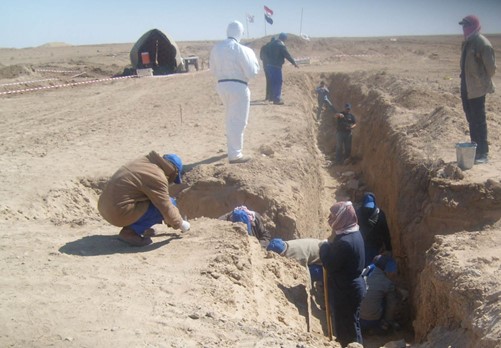 Iraqi national team in 2011, excavating long trenches in the desert near Ramadi, containing victims of Saddam Husseins regime.
From 2014 they investigated ISIL (Da’esh) atrocity crimes, with UNAMI/OHCHR documenting 202 such mass graves and other atrocity crime scenes by 2018, evidence used in frequent trials. UNITAD have assisted the Directorates (2018-2024) in excavating some 74 mass graves to date related to crime against the Yazidis, recovering 1,283 sets of remains. In 2026, a national Iraqi DNA matching and identification program remains under development. Compensation can be claimed for designated victims’ families, but the scheme is onerous and bureaucratic. The Directorate for Yazidi Female Survivors Affairs has paid compensation since 2021, with August 3rd designated as a National Day of Remembrance for the Yazidi genocide.
Cambodia
In Cambodia, The Documentation Centre of Cambodia (between 1995-2007) had listed 19,733 mass graves, containing an estimated 1,386,734 victims of execution. Preliminary plans for exhumations were not fulfilled. The ECCC prosecuted only a few senior individuals during its mandate, with others dying or deemed unfit before they could be brought to trial. The court finishes its mandate in 2027. No forensic experts or forensic evidence contributed to trials. Mass exhumations took place in many places, for example at Choeung Ek, where 89 mass graves out of the estimated 129 graves were exhumed in 1980, with a total of 8, 985 skeletons reported to have been moved to memorial stupa. Forensic review of the remains in memorials found widespread evidence of violence and trauma, but there has been no formal identification process. Cambodia still has limited day-to-day capacity to investigate suspicious or violent deaths. The ECCC awarded limited reparations focused on memorialisation, participation in proceedings and psychological support and education measures. There is a National Day of Remembrance (20 May) commemorating victims of the Khmer Rouge, but for surviving family members, there is little prospect of identifying relatives.
The Potential for Effective Investigation
These case studies exemplify the scale and complexity of events that investigations have faced over the last 30 years. The need to effectively gather evidence of crimes, identify the missing and document events to fulfil obligations has been recognised and further codified during this intervening period.[3]
All countries have been severely impacted by conflict, with overwhelming scales of Missing and documented atrocity crimes, non-functioning post-conflict institutions, and varied ability (or desire) to undertake and deliver investigations. Responses have also differed depending on justice and cultural concepts.
What is clear is that effective investigation responses cannot be achieved if there is limited understanding of what is possible in practical terms, and how multidisciplinary and interdisciplinary investigations can provide successful outcomes to fulfil international obligations.
Countries responding to atrocity crimes need basic forensic and medico-legal capacity that can then expand to meet the scale of atrocities. Inevitably the scale of atrocity crime events will outstrip both standing national forensic capacity (if it has survived conflict) and management understanding of how the tackle such problems. Many countries do not have that foundation post-conflict, and it has still not fully developed in 30 years.
30 years of investigations demonstrate multidisciplinary forensic investigations can gather evidence concerning atrocity crime events, can locate victims, retrieve victims, and document a wide variety of evidence concerning cause and manner of death, providing evidence linking crime scenes, victims, and perpetrators to events. This evidence can be utilised by prosecutions. Mass identification of victims can be achieved.
An effective scientific investigation designed with these criteria in mind can now furnish criminal evidence for courts, provide evidence for identification of victims, provide dating of events, confirm events, and contribute to accurate narratives of events.
Investigations that do not follow such practice risk failing to achieve their objectives, and leave evidence open to criticism and revisionism, leave the missing unlocated and unidentified, perpetrators avoiding prosecution, and families and communities left without answers and without means for redress.
There are common issues and impediments to investigation seen across the country case studies; these and the practical realities of implementing effective investigation are now widely appreciated, exemplified and described. For any investigation to be truly effective it requires the agreement, cooperation, and compliance of states, supported by international resolve.
Whether there is political, national, community and international will to ensure effective investigations are implemented in relation to global atrocity crime events going forward, remains to be seen.
In the meantime, the dead wait, often in a taphonomic statis beneath the ground, languishing in legal limbo, and political inertia.
[1] The countries discussed represent the case studies examined during MaGPIE’s two-year review of defining effective investigations: Rwanda, Guatemala, Iraq, Cambodia, and Bosnia and Herzegovina.
[2] Figure from Ian Hanson, 2023. ‘Anatomy of a Grave: The Kozluk excavations as an exemplar of a successful mass grave investigation.’ In Ellie Smith and Melanie Klinkner (eds) Mass Graves, Truth and Justice: Interdisciplinary Perspectives on the Investigation of Mass Graves. Cheltenham. Edward Elgar Publishing. pp. 50-79.
[3] Including the updated ‘Minnesota Protocol on The Investigation of Potentially Unlawful Death, 2016’, under ‘D. Elements and Principles of Investigations’. UNHR 2017.