Anna Charlton
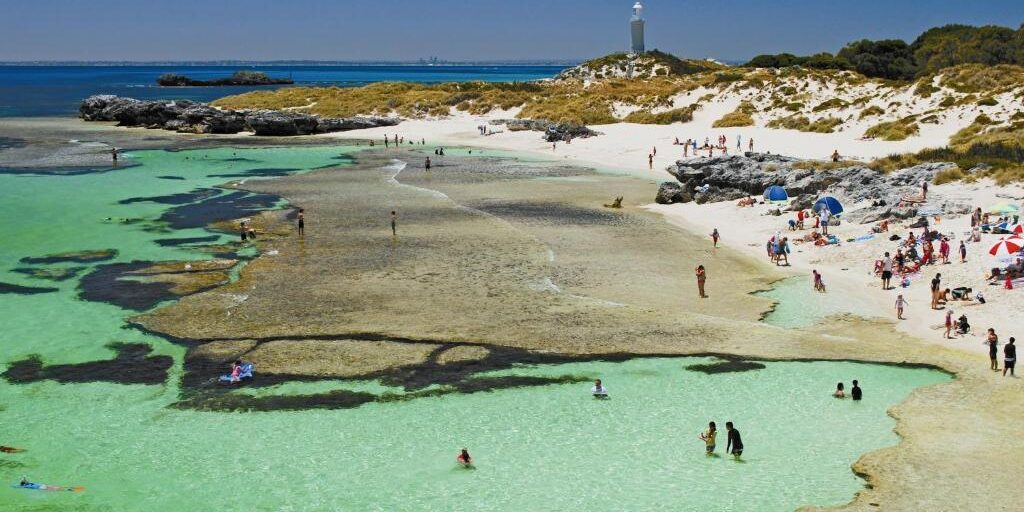
Wadjemup Rottnest Island is an island 20km off the Western Australian (WA) coast. Today, for the hundreds of thousands of people that visit each year, it is one of WA’s most popular tourist destinations – famous for its pristine beaches, cycling, snorkelling and quokkas – but for First Nations communities, it holds a profoundly different significance.
Wadjemup is part of the traditional lands belonging to the Whadjuk Noongar nation and is a sacred place of cultural and spiritual importance. It is also site of grief, trauma and gross injustice owing to its use as a prison for Aboriginal men and boys between 1838-1931, during which time up to 4000 people were brought to the island from across the state, including boys as young as eight and senior law men. At least 373 never left and were buried on the island in unmarked mass graves.
When Wadjemup was designated for conversion to a holiday destination in 1907, Aboriginal prisoners were still being held on the island, building critical infrastructure that remains in use today. The last prisoner left in 1931, marking the end of Rottnest Island’s use as a prison and a turning point in its new identity as tourist resort, with the former prison cells in the Quod converted to hotel rooms. In the 1970s, as the island continued to expand for tourism, human remains were found near the main settlement but were reburied and unreported. In 1985, after over a decade of activism by Aboriginal family members and communities, the mass grave site was formally recorded and protected under the Aboriginal Heritage Act 1972. In 1993, more human remains were found in the island’s main campground, ‘Tentland’, 100 metres away. This discovery was accompanied by the formation of the Rottnest Island Deaths Group Aboriginal Corporation (RIDGAC) and finally prompted the state government to acknowledge Wadjemup as the largest site of Aboriginal Deaths in Custody in Australia, in 1994. However, it wasn’t until 2007 that ‘Tentland’ finally closed, with thousands of holidaymakers having camped upon the unmarked graves up until this time. In 2018, after prolonged pressure from Aboriginal communities, the Quod closed as tourist accommodation. Between 1991-2025, ten ground penetrating radar (GPR) investigations were made at Wadjemup confirming the scope of the mass grave site adjacent to the former prison.
Wadjemup Rottnest Island represents an interesting and important case study, not only specific to Indigenous rights surrounding mass graves linked to colonisation, but in the actions and processes employed by settler-state governments in reconciling and acknowledging historical human rights abuses by the state. In 2020, the Western Australian government initiated a new process for reconciliation and healing on the island – the Wadjemup Project – announcing the implementation of a Cultural Authority Reference Group, led by Traditional Owners, the Whadjuk Noongar people, that would undertake state-wide consultation regarding the future of the known mass grave site and the Quod. The Wadjemup Project is considered one of Australia’s first large-scale acts of recognition related to the impacts of colonisation on Aboriginal peoples.
Truth-telling has increasingly been integrated into learning and knowledge-sharing opportunities on the island, through archival exhibitions, ceremony, workshops and artwork displays. An inaugural Aboriginal art exhibition (October 2025 – April 2026) at the Wadjemup Museum, Connections to Wadjemup, forms part of ongoing efforts to reclaim the narrative of Wadjemup and re-centre Aboriginal perspectives on the island. The exhibition recognises an important truth: that visitors continue to walk upon the island “largely unaware of the sacred, concealed layers of the island beneath their feet.” This sentiment is not new; it was vividly depicted by Palyku and Nyamal artist, Sally Morgan, in her painting ‘Greetings from Rottnest’ (1988), in which holidaymakers can be seen waving and smiling in the sun, with seven rows of human burials beneath their feet.
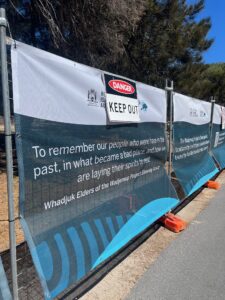 Over fifty years since human remains were re-discovered at Wadjemup, restoration and memorialisation projects at the former prison and burial ground are now underway. It has continued to be a lengthy process tied in a complex relationship with the island’s primary function as a thriving tourist destination, which was described in the Rottnest Island Authority’s Annual Report 2024/25 as a “beacon of Western Australia’s tourism excellence”. The inherent tension in Rottnest Island’s ‘tourism excellence’ and its dark colonial history reflects another important truth: that knowledge does not always mean, or lead to, action. The reality of Wadjemup post-colonisation as a site of sadness and suffering for Aboriginal peoples has been widely discussed. The brutality and mistreatment of prisoners was well-documented at the time, with investigations into the actions of infamous first Superintendent of the prison, Henry Vincent, made throughout his lengthy time in charge on the island. These histories are recorded in archives, re-told through family stories, and felt by communities ostracised by Rottnest Island’s tourism focus. Yet years of concealment and inaction have seen significant phases of redevelopment, construction and recreation take place “over or adjacent to burial grounds” across the island without fair or meaningful consideration of the rights of the people buried there, or their families.
Rottnest Island’s ongoing and established position as a leading tourism destination has created a challenging environment for truth and reconciliation both practically and culturally. Growing infrastructure, increasing visitors years on year; histories made vague, consciously forgotten and re-told, Wadjemup continues to be in a state of transition and remembering. With Aboriginal-led consultation now providing the cultural authority to develop a pathway to reconcile Rottnest Island’s history, there is opportunity and a hopeful sense of change. However, with records indicating the existence of at least one or two further unmarked mass graves on the island, no investigation pending, there is still the need for fuller, more appropriate engagement with Aboriginal mass graves and Indigenous rights. While attention has increased considerably in recent years upon truth-telling and memorialisation, the legal rights of those buried on the island and of their families – and the obligations of the state – have not been as closely examined. Until such a time, meaningful reconciliation may be an unfulfilled promise.
A note on place names: Wadjemup is the traditional Whadjuk Noongar place name for Rottnest Island. Increasingly, both names are used together in recognition of its history. Here, I have used the names together and interchangeably, primarily using ‘Rottnest Island’ when referring to its colonial use as a prison, or as resort managed by the Rottnest Island Authority.